I’ve talked a bit before about recognizing the emotionally disturbed person (EDP) and offered some tips on dealing with an EDP. If I haven’t stressed the importance of how dangerous an EDP can be, let me do so now.
EDPs by there very nature are unpredictable and unlikely to deal with you in a completely rational manner. As a result, a calm EDP can instantly become violent without any discernible trigger. So, do not be lulled into complacency when dealing with someone who may be disturbed.
EDPs frequently perceive reality differently, and understanding that may help explain their behaviors. For example, several years ago I dealt with a man who went off his meds and began thinking that the people he was seeing were aliens wearing “human suits.” And this was before Men in Black
. So he went out in the neighborhood with his MAK-90 rifle with the intent on stopping the invasion. Fortunately, we found him before he caught any aliens and no one was shot that night.
The point, though, is to look at things through his perception of reality. This EDP felt completely justified in shooting some people because he thought he would be killing alien invaders. So, what if I came up on him and he thought I was a bug in an Edgar suit? Suddenly it is game on. But, I could be talking to him and everything seem ok, and then he suddenly realizes I am an alien. If I have relaxed, he may very easily get the drop on me.
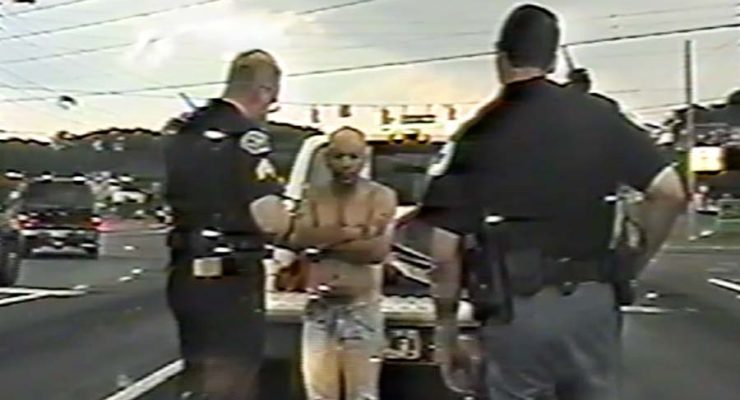
A rookie on my shift tonight spots a guy walking down the road who is wearing only socks, shorts, and heart monitor leads. The rookie is smart enough to figure out that the guy may be an escapee from the psych ward of one of the nearby hospitals and gets out with the subject. His backup officer rolls up about two minutes later to find the rookie and EDP rolling on the ground and the EDP is trying to grab the officer’s gun. Fortunately, the rookie is in solid shape and the backup officer was able to provide a bit of overwhelming force to get the guy in custody. Just another example of how an encounter with an EDP went downhill fast.
About eight hours before I went on shift tonight, a deputy with another county here in Florida was shot and killed by an EDP. It seems this EDP was taken to a psych facility for a mental health evaluation (called a Baker Act here) the previous evening. At some point the EDP escapes and then is recaptured. Then the EDP escapes from this ’secure’ facility again. When the deputies go to pick him back up, he is armed and barricaded inside a house. Eventually the decision is made to have the special response team make entry, and ultimately, a deputy and the subject were both shot and killed.
So, don’t get complacent. Read the tips I posted and make sure you are using all of your officer safety tools and tactics. You never know when an EDP will decide its time to try and kill you.
Stay safe!
Tags: EDP · Officer Safety
In tough economic times, everyone tightens their belts. Consumers spend less and politicians who never completed an Economics 101 course try to maintain or raise government revenue by raising taxes. An ugly cycle, actually.
The same politicians seem to have a misunderstanding of government’s role in society. Without sounding too much like a political blog, I believe that government should provide for public safety before worrying about public entertainment.
For example, in my city, our department suffered a rather large budget decrease this year. Fortunately, our chief is committed to not losing officers, and he was able to squeeze the money from other programs. The unfortunate part is a lot of the money came from things like training. The “good” news is the city is still able to provide summer concerts, agreed to partially fund a private company’s entertainment plans for a new residential community, and provide a lot more recreational and entertainment functions than I could list in one blog entry. Entertaining the masses trumps public safety.
Of course, things could be worse. A nearby county agency, the Pinellas County Sheriff’s Department, fired 36 detention deputies two weeks ago. Yesterday, they fired 25 road deputies. The reason? Budget cuts. And, there is no guarantee that this will be the final round of terminations. However, recreational facilities and public entertainment continues.
The Florida Department of Corrections eliminated 75 positions last fall, and had to eliminate 348 more in this budget.
Additionally, 80 Florida state probation officers just got their “pink slips.” The offender caseload for each officer is now increasing from 73 offenders/officer to a whopping 125 offenders/officer. Of course, this also means that a lot of offenders are probably going to be released from probation without serving their full sentence. Ever out of touch with reality, the Miami Herald is more upset about potential cuts to the process of restoring felons’ civil rights.
The public safety cuts are not restricted to law enforcement. There have been several fire department employees cut from the agencies around my jurisdiction. The worst case I have seen comes out of East Point, GA, a suburb of Atlanta. East Point closed two of its five fire stations and terminated about 60 firefighters last month. Do you think that affects their ability to respond to medical and fire emergencies?
Other than the obvious impact on the deputies and police officers being fired, what are the other effects that will be felt in police work in the coming years? Increased crime, longer response times, less training, and a decline in officer safety.
These are not the glory days we are approaching. Do your job, watch each others backs, commit yourself to officer safety and go home every night. It’s not the end of the world, but those of us still employed in police work are going to be busy.
Stay safe!
Tags: Officer Safety · General
The Ten Deadly Errors were part of the police academy I attended in the mid-90’s. The Errors were mentioned at the start of a officer survival training block, but they were not emphasized. I didn’t think much of it at the time, as I had been involved in armed security for several years prior to that and had read books like Street Survival on my own. The Errors were already part of my thinking.
I recently was talking to some new officers, and on a whim, I inquired about their knowledge of the Ten Deadly Errors. I was a bit stunned to learn that they didn’t really know what I was talking about. Some of the information they knew, but the information wasn’t ingrained into them.
Detective Pierce R. Brooks, a Los Angeles PD homicide detective, wrote a book called “…officer down, code 3″ way back in 1975. While I can’t say that this book was the start of the officer survival movement, it was certainly a key player. Brooks listed the Ten Deadly Errors that he identified as being the most common, repeated reasons for officers being killed in the line of duty. Brooks, some of you may recognize, was an investigating detective in the infamous Onion Field killings.
So, as a refresher to the vets, and as a learning experience for the new guys here are the Ten Deadly Errors:
1. Failure to Maintain Equipment and Proficiency - Clean your guns, magazines, and handcuffs. Keep your flashlights charged. Keep a fresh battery in your radio. Get to the range and practice shooting. Work with your zone partner on handcuffing techniques.
2. Improper Search, Improper Use of Handcuffs - A lot of cops have been hurt or killed because of a poor search. Learn how to do a systematic and thorough search of prisoners and frisks of suspicious people. Understand that weapons can be secreted anywhere on and in the body. When handcuffing, make sure they are on properly and double locked. Always handcuff behind the back. Here in Florida, we lost three law enforcement officers after a murder suspect was handcuffed in front and retrieved a handcuff key hidden on his person.
3. Sleepy or Asleep - If you do not get enough sleep, you become a danger to yourself and your partners. A lack of alertness is exceptionally dangerous.
4. Relaxing Too Soon - Do not relax until the call is over and you have left the jail and gone back in service. Most veteran officers can tell stories about a guy that was “cool” and then suddenly snapped. Offenders may act relaxed, but do not let them lull you into a false sense of security. If you slack off while around someone who wants to hurt you, you invite disaster.
5. Missing Danger Signs - Danger signs could be verbal cues, non-verbal cues, bulges, clothing, location, or any number of other things. A suspect who keeps touching his hip while talking to you could be giving you a non-verbal indication that he is armed. A suspect who doesn’t directly answer a question could be hiding information. A specific type, style, or color of clothing could be an indication of gang affiliation. Become informed of what danger signs may exist and then actively look for them.
6. Bad Positioning - Know where you are and figure out the safest place to be. For example, if you can get the cars in a traffic accident into a parking lot, wouldn’t that be a safer place than standing in the road to conduct your investigation? In a Terry Stop, how close are you to the suspect? Where is your cover officer? Can you effective respond to a sudden attack from your current position? Is there some form of cover you might be able to use?
7. Failure to Watch the Hands - Their eyes may be the windows to their soul, but their hands will kill you. Although watching the hands falls in with missing the danger signs, this error has hurt or killed so many officers, it is deserving of its own place on the list. Humans are tool users. With little exception, this means offenders will use their hands to obtain a weapon to attack you. Hands will retrieve a gun from the waistband, a knife from the pocket, or a baseball bat from behind the door. Can you see their hands? Where are the hands? What are they doing?
8. Tombstone Courage - Don’t rush in if you don’t need to. Take your time and wait for backup. Sometimes you have to go in alone. Most of the time you don’t, so wait for your partner!
9. Preoccupation - If you are messing with your computer or cell phone, how can you watch their hands or pick up on other danger signs? Also, if you are so stressed about your finances, relationship with your spouse, or about your drinking problem, how are you supposed to remain alert all shift? If you are stressed out, talk to a peer counselor or request help from the employee assistance program at your agency. There is no shame in asking for help, especially if it can prevent you getting hurt on the job.
10. Apathy - Don’t think it can happen to you? Think again. Bad things happen on all sorts of calls, on all shifts, and to officers of all levels of experience.
Stay Safe!
Tags: Officer Safety
The U.S. Supreme Court ruled that the Second Amendment is an individual right and that the District of Columbia violated that right with the ban on handguns and assembled long guns.
A complete analysis is available here.
Tags: General
I’ve just gone through and added a stack of training classes that have been e-mailed to me relating to handgun shooting, basic rifle training, close range defensive shooting, and the Street Survival Seminar training.
Check out the police training courses here.
As always, if you have any training classes coming up, e-mail me the information and I will be happy to post it.
Tags: Officer Safety · Firearms Training · Training
The National Rifle Association’s Law Enforcement Activities Division is sponsoring the 2008 National Police Shooting Championships this year in Albuquerque, NM. The championships will run from September 21 - 25 and will feature some of the best competitive shooters found in law enforcement from around the world.
Eligibility to shoot in this august event includes you be a full-time civilian or military law enforcement officer and that you are a member of the NRA. Other rules, such as classifications are found in the rule book here.

Tags: Firearms
I had an interesting call tonight. A woman calls from a residence stating that she thinks her roommate is trying to cook meth. She tells the 911 operator that he is heating acid on the kitchen stove, lots of noxious smoke is in the house, and she and/or someone else inside the residence is having problems breathing. Dispatch sends three units plus the fire department is also responding.
Seems pretty straightforward, right? Not so fast.
Think about it. Meth production is a deadly undertaking. Nasty things like phosphene gas are common by-products of methamphetamine production. Police officers walking into that environment can become very dead, very quick. Us beat cops can’t just walk in there…we would likely become victims also.
So, the solution is: the firefighters with their respirators and haz-mat gear go in and get the ‘victims’ out. Well, not really. Remember folks making meth tend to be violent criminals. They like to fight, have guns, and are generally anti-social. Firefighters going into that situation are in danger from the victims.
What is the solution? Pre-planning, flexibility, and a great deal of cooperation between agencies.
Working out the possible responses with the likely responders (PD and FD, for example) ahead of time, is a really smart move. This allows everyone to critically think through possible problems, iron out differences in policies between agencies, and gives everyone a baseline to work from when they get on scene.
What kind of training and equipment do the beat officers and other first responders need when they arrive on scene? Figure out what resources and skills you need…and are reasonably expected to be available…and work up a plan. The world’s best equipped and trained clan-lab team is worthless in the situation I responded to if they are 30 minutes or more away. The people inside will be long dead before they pull on the first leg of their nomex suit.
The DEA and regional drug task forces offer training in clan-lab response. Sending a few selected police officers and fire fighters to these classes can give them the information they need to design a workable response plan.
However, the guys on the ground have to be flexible and willing to cooperate to get the job done.
In my call, the firefighters were willing to work with us and we got the call done as safely as possible under the conditions. Was it perfectly safe? Nope, and that is what we work on for next time.
Stay safe!
Tags: General
Yet another example of how a police officer should carry off-duty 100% of the time. This example is from New York. The detective in question saved his life plus that of another.
NEW YORK — An off-duty detective who had been chatting with a condominium building receptionist in the lobby shot and killed one of two men who slashed them with razor blades or broken glass during a robbery attempt, police said.
The desk clerk, Artenida Gjeli, had called the detective, Martin Carrano, to her Manhattan building Wednesday night to discuss harassing telephone calls she’d received from an ex-boyfriend, police said. They were discussing the case around 10:30 p.m. when two men entered the lobby of the six-story residential building in Chinatown and asked if there were rooms for rent.
When Gjeli, of Lodi, N.J., told the men they weren’t in a hotel, they jumped the detective and slashed his head, police Commissioner
Ray Kelly said. The muggers then hurtled over the reception desk and began mauling Gjeli, he said.
“She slid to the floor and attempted to fight her assailants as they continued to slash her with sharp objects,” Kelly said.
The detective, a 20-year veteran who knew Gjeli through earlier work on her harassment complaints against her ex-boyfriend, drew his gun and “ended the assault” by firing about 10 shots, hitting both attackers, police said.
One attacker was hit in the abdomen and died at the scene. The other was wounded in the abdomen and right arm and was taken to a hospital, where he was listed in stable condition Thursday. Police didn’t reveal the men’s identities.
The 39-year-old detective needed stitches to close cuts on his head and neck, and the 28-year-old receptionist was hospitalized for cuts to her left hand, right leg and face. Their injuries weren’t considered life-threatening.
The woman’s relatives said that the thugs had “tried to kill her” and that the detective had “saved her life.”
“They stabbed her in the face and leg,” uncle Musa Gjeli said. “She’s lucky.”
Tags: Officer Safety · Firearms
Smith and Wesson has always been a mainstay in the police sidearm market. Smith and Wesson’s latest pistol series, the Military and Police (M&P), has become wildly popular with officers and citizens alike. To date, more than 330 police departments have issued the M&P pistol as the standard handgun in 9mm, .40 S&W, or .45 ACP. The newest department to adopt the M&P is the Worcester, MA Police Department.
Smith & Wesson announced that it has shipped an order for 500 of the company’s M&P45 pistols to the Worcester, Massachusetts Police Department (PD). The M&P45 will be issued to each officer in the department to replace non-Smith & Wesson pistols that previously served as Worcester PD’s primary duty firearm.
Officials at the Worcester PD indicated that they selected the M&P45 because of its unique design features, modularity and reliability during testing. After a standard testing and evaluation period, Worcester PD officials noted the accuracy of the M&P45 pistol and the ability of each officer to select the grip size of his or her preference.
Gary J. Gemme, Chief of Police for the Worcester PD, said, “During our selection process, we tested a variety of firearms from numerous manufacturers. From the beginning, it was decided that a pistol chambered in .45ACP was the preferred choice. The M&P45 supplied our officers with the best combination of features to suit our duty needs while being chambered in the more powerful .45ACP cartridge. The pistol performed well throughout the testing process in both accuracy and reliability and the pistol’s interchangeable grip sizes allowed for a custom fit to each officer’s hand size. Through our relationship with Smith & Wesson, we are able to provide our officers with the tools necessary to complete their jobs while working to enhance the safety of our police force and community.”
Worcester PD joins a growing list of police agencies near Smith & Wesson headquarters that have selected firearms from the M&P Series for duty use. Other agencies in the Massachusetts area that have converted to the M&P pistol include the Brookline Police Department; West Springfield Police Department; Agawam Police Department; Swampscott Police Department; Winthrop Police Department; Sharon Police Department; Palmer Police Department and the Hampden County Sheriff’s Office. In addition to these local law enforcement agencies, the M&P pistol has been previously selected as a primary duty firearm in the Waterbury, Connecticut Police Department along with the Hartford, Connecticut Police Department.
Leland Nichols, President and Chief Operating Officer of Smith & Wesson Corp., a wholly owned subsidiary of Smith & Wesson Holding Corporation, said, “Smith & Wesson is committed to serving police departments and security agencies around the globe, including those that are in our own local communities. By providing these professionals with the most current and highly specialized equipment available, we are helping them to complete their jobs in the most efficient manner while continuing to deliver on our reputation for safety and security. We look forward to working with the men and women of the Worcester PD along with all of the other law enforcement agencies that have selected firearms from the M&P line for duty use.”
The M&P pistol features a polymer frame reinforced with a rigid stainless steel chassis and a through-hardened black Melonite(R) finished stainless steel barrel and slide for durability; a passive trigger safety to prevent the pistol from firing if dropped; and a sear release lever that eliminates the need to press the trigger in order to disassemble the firearm. A loaded chamber indicator is located on top of the slide. The firearm also features an ambidextrous slide stop and a reversible magazine release, as well as an enlarged trigger guard designed to accommodate gloves. Each M&P pistol is equipped with three interchangeable grip sizes that allow the user the custom fit the gun to their preference. The M&P45 has a 10+1 capacity and the Smith & Wesson lifetime service policy is standard with each pistol. The M&P pistol series is available in 9mm, .40S&W, .357SIG, and .45ACP calibers. Compact versions of the M&P pistol are also available for concealed carry and back-up use.
Tags: Firearms
SIG SAUER wants to express their appreciation to individual officers, military, and first responders for their service to our country, both foreign and domestic. As a small token of appreciation, SIG SAUER will be offering a special rebate program on new SIG SAUER pistols and rifles. This offer is available to all first responders, active and retired law enforcement officers, active duty, retired military with a retired military ID, and active reservist military personnel. Recently discharged military personnel are eligible to purchase a firearm up to 90 days from date of separation. Rebate forms for the Individual Officer Program can be downloaded at www.sigsauer.com.
Offer applies to the firearms listed below. Firearm must be purchased between January 1, 2008 and December 31, 2008 (does not apply to previous purchases).
$100 Rebate applies to the following models - P220®, P226TM, P229®, 1911, SIG556TM, SSG 3000, Blaser Tactical 2
$50 Rebate applies to the following models - P239TM, P250TM, SP2022®.
This offer applies to purchases made through authorized dealers only and does not apply to the 2008 P220R3 Carry C.O.P.S. Edition model, P232TM model, Certified Pre-owned models, or Mosquito® pistols. All requests for rebates must be postmarked by December 31, 2008 to be assured reimbursement. Offer void where prohibited.
To inquire about the SIG SAUER Individual Officer Purchase Program email carol.bradanini@sigsauer.com or call (603) 686-5657.
Tags: Firearms
I stopped a woman for an expired tag. I soon arrested her for Driving While Suspended/Revoked as her history of poor driving makes it a felony for her to operate a motor vehicle. So, I am sitting there waiting for a tow truck to show up for the car, when a subject (here-after referred to as ‘dude’) walks up.
Dude asks “Do you work around here?” I point to the flashing lights on my patrol car and say “Yep. It’s not just a hobby.” Dude says “Good. My girlfriend, Donna, has a warrant. She won’t turn herself in. Would you arrest her?”
Now I’m thinking “That’s love.” So I say, “Sure where is she?” Dude points vaguely toward a nearby trailer park that is in the county’s jurisdiction. I explain to Dude that the trailer park is in the county, but I can have a deputy meet him at their abode.
Dude gets quiet as he appears to mull over my offer. After several minutes, he looks up at me and says he will be right back. Dude leaves and I figure he’s had enough interaction with the police for one night.
About five minutes later, I am typing away on my computer terminal and I see this woman walking past my patrol car. I am thinking “No…It can’t be.” On the other side of the parking lot I see Dude making some not-so-sly head movements toward her in an obvious attempt to get me to stop her.
I ask the woman “Are you Donna?” The woman stops and says “Yeah, why?” I say “I heard you have a warrant.” Donna, who is nervous, gives me her information. Much to my disappointment, Donna was not wanted. Donna wanders off.
Once Donna is out of sight, Dude slides up to my car wanting to know why I didn’t arrest her. I say “Well, she’s not wanted. By the way, do YOU have any ID?”
Dude was wanted. Ah…irony.
Tags: General
Police officers have enjoyed the use of the Taser X26 (and the effective M26 before that) as an excellent intermediate force option that allows the quick incapacitation of an offender while minimize the chance of harm to the suspect and officers involved. Tasers tend to be effective where pain compliance techniques are not.
However, Tasers are not 100% reliable. For the Taser to work properly there has to be a completed circuit with electricity flowing through a wide section of muscle mass. The failure of a Taser to effectively work can happen if only one probe hits the suspect, or the probes land too close together, or there is a faulty battery, or thick clothes do not allow the probes to get close to the skin. I’ve seen Tasers fail to incapacitate in each of these situations. The point is: the X26 is effective but not 100%.
There is an understandable reluctance by police officers to use deadly force. Cops are not evil people and they do not want to harm or kill anyone. So, many times when a police officer faces a situation in which deadly force is the appropriate level of force, the officer may hesitate or seek some other lower level of force, which generally decreases their own safety. While in some respects this is admirable, the fact is the officer must survive and win the encounter, not just for his or her own well being, but for the community as a whole. For if the officer is incapacitated or killed due to their attempt at a lower force option, their killer is now free to harm other innocents…perhaps even with the officers own weapons.
If a police officer encounters a suspect armed with a deadly weapon, the officer’s appropriate response will be deadly force, not a Taser. A suicidal subject armed with a knife or a gun needs to see the business end of your AR, shotgun, or pistol…not the blast doors of a ‘green’ X26 cartridge. If you have appropriate deadly force cover (say your two zone partners are in a position of advantage covering the suspect with .223 rifles), then you might –in certain circumstances– attempt to use a Taser to subdue the suspect. The idea is that your backup can employ deadly force should the Taser attempt go wrong.
Keep in mind that the vast majority of us have Taser cartridges that are good to a maximum of 21′ or 25′. Perhaps 21′ sounds familiar? That distance should be known to all police officers as it relates to the Tueller Drill. The Tueller Drill was developed by Sgt. Dennis Tueller of the Salt Lake City PD. Sgt. Tueller discovered that an average person could cover 21′ and begin stabbing an officer in 1.5 seconds: the same amount of time an officer could draw his weapon and put a round on the threat. That, of course, does not take into account that a fatal shot is not likely to instantly stop the attack.
So, if you encounter a violent subject armed with an edged weapon AND you have lethal force cover AND you want to try to use a Taser, you better hope it works. If it doesn’t, you will likely have a subject on top of you in less than two seconds. Your partners better be very accurate and very quick. Even then you stand a pretty decent shot at getting hurt.
If the subject has a firearm, you don’t even have 1.5 seconds, as they just have to point and pull the trigger.
So, read your department SOP’s, know your state laws of the use of force, and work out plans with your zone partners before you encounter a deadly force situation in which you may want to try a Taser.
Tags: TASER · Edged Weapons · EDP · Drugs · Officer Safety · Firearms Training
Gould & Goodrich has added a Taser Holster/Cuff Case combination to its product line to make the most efficient use of available space on duty belts. The product is offered in Hi-Ride Cross Draw, Swivel Cross Draw, or Strong Side Use and is available in K-Force (black, waterproof polymer laminate with a choice of black, black basketweave or hi-gloss Porvair finish) and Phoenix Advantage-Plus Nylon (genuine ballistic nylon that resists moisture, mildew, scratches and tears).The Taser Holster/Cuff Case combo requires only the space on the belt that is normally used by the cuff case alone. This frees up space on the belt, which can then be used for other accessories.
“We’re very pleased to offer Law Enforcement Professionals options that increase the ability to carry their equipment conveniently and comfortably,” said Robert Gould, President of Gould & Goodrich. “In addition to the stocked items in our catalog, we specialize in creating custom products for Law Enforcement, Government and Military agencies.”
Tags: Gear and Holsters
Police officers receive a lot of training in vehicle pursuits, yet most cops get very little training in foot pursuits. The reason comes down to lawsuits.
If an officer initiates a vehicle pursuit and subsequently the suspect or officer strike an uninvolved citizen, the officer’s city will be facing an expensive lawsuit. If the same officer engages in a foot pursuit, there is a significantly smaller chance for the criminal or officer to seriously hurt or kill someone by running into them. Hence, significantly fewer lawsuits.
However, the city’s perceived “danger” should not be your perception as well. Every year, police officers are murdered when engaging in foot pursuits. Take the murder of Cleveland Police Officer Derek Owens who was shot during a foot pursuit on February 29. Owens and his partner chased several suspicious men who fled on their arrival. While being chased, one of the men produced a handgun, turned, and shot Officer Owens.
K-9 officers are especially vulnerable in a pursuit. K-9 officers frequently are chasing suspects, and probably find themselves more vulnerable than most patrol officers. Deputy Sheriff Matt Williams and his canine partner Diogi were murdered on September 28, 2006 when they gave chase after a man who had fled on foot from a traffic stop in Polk County, Florida.
So, what are some of the things you can do to make a safer pursuit?
- Don’t Push A Bad Position - If the suspect has gotten out of sight, slow down. If you have the units available, set up a perimeter and get K-9 enroute to assist with a track.
- Negotiate Corners Safely - If the suspect turns a corner, slow down and carefully negotiate the corner. Swing wide, slicing the pie as you go. Yes, this takes time, and the suspect may use the extra time to get away, but running headlong into an ambush is a fatal mistake.
- Anticipate Trouble - Sometimes just showing up will cause your suspect to flee. However, if you are already in contact with your suspect, pay attention to the body language he is displaying. If your suspect is thinking about running, he will typically telegraph his intentions in his non-verbal communication. Even if you miss some of the cues, your partner should pick up on the signals if the two of you are using Contact and Cover techniques.
- Stay Physically Fit - If you catch the suspect, you have to be fit enough to effect the arrest. If you are at the point of exhaustion when you catch the suspect, how can you handcuff or fight him?
Stay Safe!
Tags: Officer Safety
The Ghost Hawk Neck Knife offered for sale by GG&G is a concealable knife of an unusual shape and design. The knife weighs a mere 1.65 ounces and comes with a Kydex sheath for wearing around the neck. The knife, which is only 0.1″ thick, could easily be concealed under a t-shirt, sweater, or sweat shirt.
Like any weapon, the Ghost Hawk Neck Knife could be carried by both the good guys and the bad guys. A lot of you probably already carry some type of knife around your neck or on your vest already. When doing searches, just keep in mind that your suspect can carry weapons in these places also. Too often, I have seen veteran officers search the waist bands and pockets very well, but practically ignore the neck, chest, and back.

Tags: Disguised Weapons · Officer Safety